
Pumping
The vacuum truck empties the liquid and loose solids through the manhole. It is faster and fine for a tank that was cleaned recently. It leaves the hard sludge cake and most of the scum mat behind.
Full tank clean-outs for Capital Region homes: sludge and scum removed, baffles and filter checked, and a clear report on what we found.
Get a Free Quote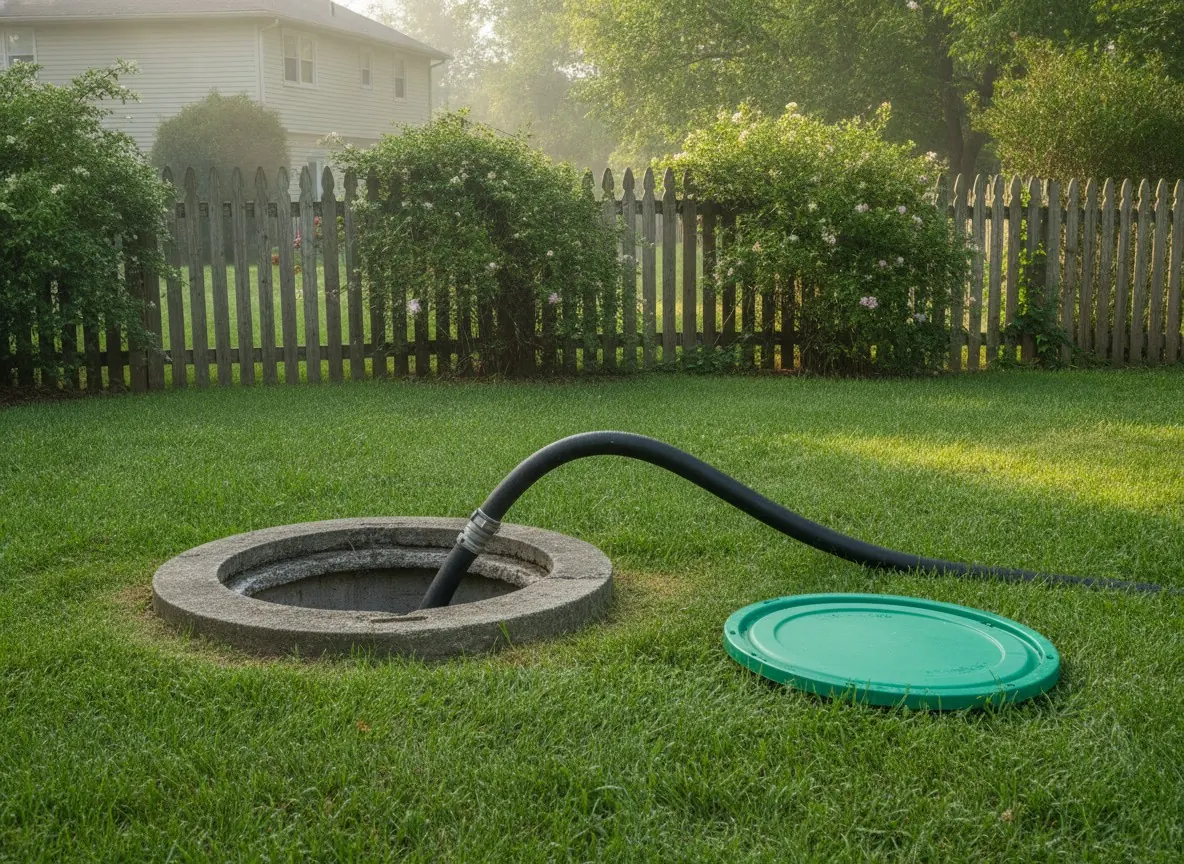
Every septic tank in Albany, Rensselaer, Saratoga, and Schenectady counties does the same job: it holds wastewater long enough for solids to settle to the bottom (sludge) and fats and oils to float to the top (scum). The clear layer in the middle flows out to your drain field. When sludge and scum build up, they take over that middle layer and solids start leaving the tank. That is what kills leach fields in Glacial Lake Albany clay, where the soil already drains slowly.
A quick pump-out drops the liquid level and takes the loose solids. A proper cleaning takes the compacted bottom layer too. If the last company only sucked out the liquid, you are paying again sooner than you should.
Homeowners search for both terms, and companies use them loosely. Here is how we define the work on your quote.
The vacuum truck empties the liquid and loose solids through the manhole. It is faster and fine for a tank that was cleaned recently. It leaves the hard sludge cake and most of the scum mat behind.
The hauler agitates and backflushes the tank so the sludge layer breaks up and comes out with the liquid. Walls, inlet and outlet baffles, and the effluent filter get rinsed and checked. The tank starts over at close to empty.
Rule of thumb: if it has been three or more years, or you do not know when the tank was last serviced, ask for a cleaning, not just a pump. The price difference is small compared with a drain-field repair.
If any of these are happening now, read the full list of warning signs or skip straight to a free quote. If sewage is backing up into the house, go to emergency septic pumping instead.
If you have a riser, this takes a minute. If the lid is buried, the hauler probes and digs to reach it; a typical locating and digging charge is $50 to $200, more in frozen ground.
The hauler measures the scum and sludge layers. This tells you whether your pumping interval is right or needs to be shorter.
The truck removes the liquid, then uses it to break up the sludge cake so it can be removed too. Heavy sludge may need extra water.
Inlet and outlet baffles are checked for damage, the effluent filter is rinsed, and the hauler looks for cracks, root intrusion, or signs of backflow from the drain field.
The lid is resealed and backfilled. Septage goes to a permitted facility such as the Albany County North Plant or a Saratoga County Sewer District receiving station. You get a short written summary.
See the full service process for what to do before and after the truck arrives.
Typical ranges by tank size. Your quote is set after we know the tank size and how easy the lid is to reach.
| Tank size | Typical range |
|---|---|
| 750 gallon | $225–$450 |
| 1,000 gallon (most 1–3 bedroom homes) | $275–$550 |
| 1,250 gallon (4 bedroom) | $325–$650 |
| 1,500 gallon (5 bedroom) | $400–$800 |
| Locating and digging a buried lid | +$50–$200 |
| Effluent filter cleaning | $75–$200 |
Appendix 75-A sizes new tanks at 1,000 gallons for one to three bedrooms, 1,250 for four, and 1,500 for five, so most Colonie, Clifton Park, and Bethlehem homes fall in the first three rows. Full details and add-ons are on the septic pumping cost page. If the lid is deep, a one-time riser installation removes the digging fee from every future visit.
Pumping removes the liquid and most of the solids through the access lid. Cleaning goes further: the hauler breaks up the compacted sludge layer on the bottom and the scum mat on top, rinses the tank walls and baffles, and checks the effluent filter. Most Capital Region homes need a full cleaning every few years, with pumping in between if the household is large or uses a garbage disposal.
The EPA recommends inspecting a system every three years and pumping every three to five years. New York Appendix 75-A sets no statewide pumping schedule, but some towns do: the Town of Malta code requires pumping by a licensed hauler at least every three years. A family of four on a 1,000-gallon tank usually lands at the shorter end of the range.
A routine cleaning on a 1,000-gallon tank with an accessible lid takes about 30 to 60 minutes. Larger tanks, heavy sludge, or a buried lid that has to be located and dug out can push it to two hours. The hauler will tell you if the sludge is thick enough to need extra time or water to break it up.
Most households do not need yearly cleaning. Pumping too often is not harmful, but it is money you do not need to spend if sludge and scum are still well below the outlet. The exception is a small or undersized tank, a large family, or a home on a watch list such as the Halfmoon MS4 yearly-inspection area, where the town code says to pump once scum is within 3 inches or sludge within 10 inches of the outlet.
No. The tank has to be emptied before the walls, baffles, and filter can be rinsed and inspected. Additives sold as a substitute for pumping do not remove solids; they only move them around, and some can push sludge out into the drain field. Pumping is the only way to actually take the material off your property.
Residential cleaning across the four-county Capital Region.
Not sure how often your household should be on the schedule? Read how often to pump a septic tank in upstate NY.
Free quotes across Albany, Schenectady, Rensselaer and Saratoga counties.